
Largest Cities in Europe: Istanbul Leads a Sourced Population Ranking
Compare Europe’s five largest cities using UN 2025 population estimates, see how Istanbul is counted, and prepare a sourced public table.

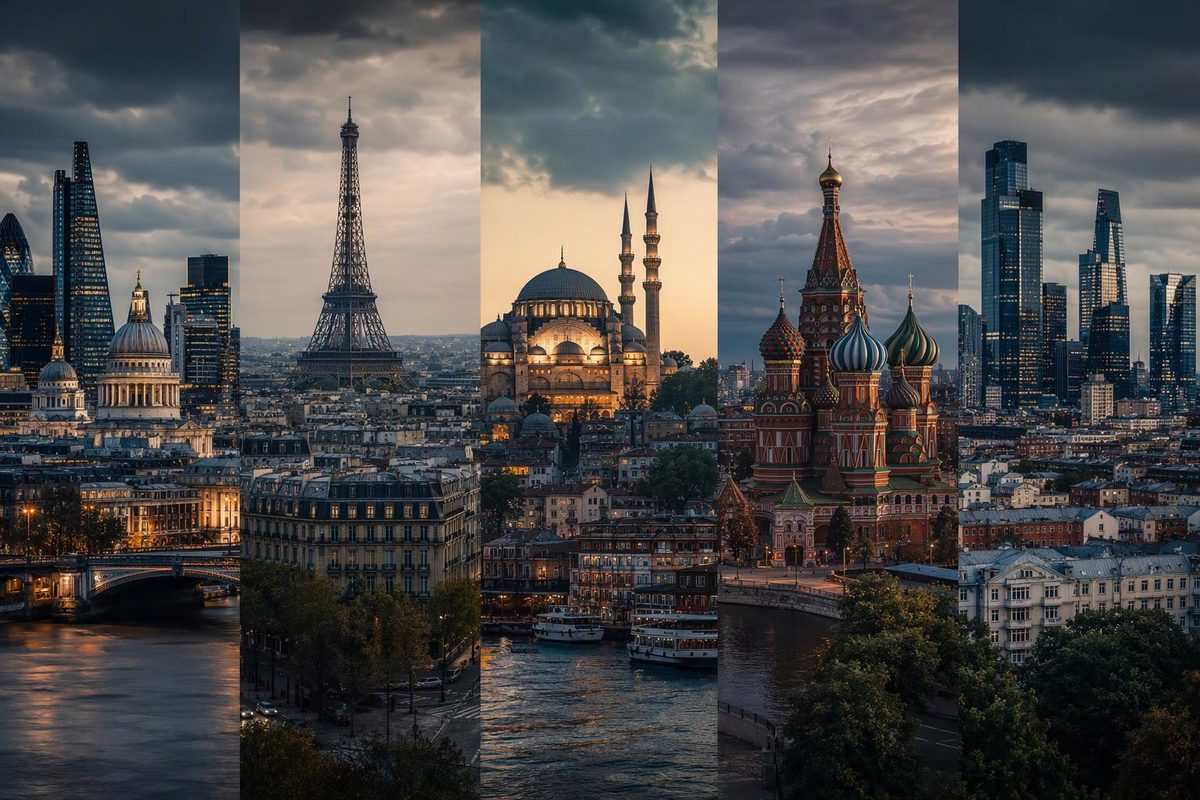
Including transcontinental Istanbul, Istanbul leads this population ranking at about 15.0 million people, followed by Moscow at 14.5 million and London at 10.4 million. These are estimates for 1 July 2025 under the UN’s harmonized city definition—not municipal populations or a mixture of metropolitan-area totals. Source: UN World Urbanization Prospects 2025, annex table 3.
For a public spreadsheet, readers need the population unit, reference date and geographic scope alongside the numbers. The table below provides a five-row comparison you can prepare for publication.
The five largest cities in Europe by this definition
This comparison covers cities in Europe including transcontinental Istanbul, and counts the full UN-defined city for each row. Istanbul lies on both sides of the Bosporus, the boundary between Europe and Asia; its figure below is not an estimate for its European side alone. Source: Council of Europe.
| Rank in this comparison | City | Country | Population, millions, 1 July 2025 |
|---|---|---|---|
| 1 | Istanbul | Türkiye | 15.015 |
| 2 | Moscow | Russian Federation | 14.525 |
| 3 | London | United Kingdom | 10.416 |
| 4 | Paris | France | 9.382 |
| 5 | Madrid | Spain | 5.584 |
Table source: UN, The World’s Cities in 2025, annex table 3. These are the five cities in this scope exceeding 5 million inhabitants. The source reports population in thousands; the table converts those values to millions. Regional ranks are assigned here, not copied from the UN’s worldwide rank column.
Excluding Istanbul makes Moscow first in this comparison. An EU-only ranking would be a different dataset, not another label for this one.
Why other lists give different answers
“Largest” here means most populous, not greatest land area. The city boundary matters just as much as the metric.
- City proper: population within the city’s administrative boundary.
- Metropolitan or functional area: a wider region that can include surrounding communities linked to the city.
- UN Degree of Urbanization city: a spatially defined, contiguous area using consistent population and density criteria.
For its 2025 revision, the UN defines a city as a contiguous geographic area with at least 50,000 inhabitants and a density of at least 1,500 inhabitants per square kilometre. The method supports international comparison without replacing national definitions. Source: UN city-definition explanation.
That is why these figures should not be relabeled “city proper” or “metro population.” Nor should a change from an older ranking automatically be interpreted as population growth: the UN’s 2018 revision used mostly country-specific definitions, and the 2025 methodology changes which areas count as a city. Source: UN discussion of the definition change.
Prepare the table for publication
Start with the UN’s downloadable city workbooks. File F19 contains the time series for the 100 largest cities in 2025; file F21 covers cities with at least 50,000 inhabitants if you want to extend the comparison.
For this five-row table:
- Select 2025 and the five cities above. Retain
City_Code,City_NameandISO3_Codeso later revisions can be matched without relying solely on spelling. These fields are documented in the F19 workbook. - Name the population unit explicitly. Store the values reported in the booklet as numeric
population_thousands—for example,15015for Istanbul. If you derive persons or millions, document the conversion. Multiplying by 1,000 does not add precision. - Keep the scope and date in the file. Suggested additional fields are
reference_date,city_definition,scope_note,source_releaseandsource_url. Preserve “Moskva (Moscow)” in a source-name field if the display name is shortened. - Sort population descending, then assign regional ranks. Keep the UN’s global rank separate. Do not mix 2025 estimates with future projections.
Export a clean CSV or XLSX containing only the intended public table. TablePage’s publishing overview supports uploading these formats to generate a public dataset page with a filterable table and shareable link. Inspect the published rows and numeric values before sharing; remove private notes or unrelated sheets before uploading.
Use a caption that carries the interpretation with the data:
Largest cities in Europe by population, including transcontinental Istanbul. Full UN Degree of Urbanization city populations, 1 July 2025 estimates. Population shown in millions; source: World Urbanization Prospects 2025.
For an expanded ranking, use the public ranking table disclosure checklist to keep coverage, missing values and release dates visible.